
Most owners sell a company exactly once. On the other side of the table sit people who do it twenty times a year. That asymmetry, more than any technical complexity, is why the process deserves attention: every mistake can only be made once.
This article describes the full arc of a mid-market sale, from the question of how your company looks to a buyer through to the day the purchase price lands in your account.
Why the process decides the price
A company has no single objective value. What it is worth depends on who is looking, what they intend to do with it, and whether they believe the numbers in front of them. All three are things a process influences.
The strongest lever is competition. A buyer who knows they are the only candidate negotiates differently from one who assumes three others are reading the same information memorandum. Nothing in a valuation model replaces that.
The second lever is preparation. Findings that surface during due diligence cost money, because at that point the buyer already holds exclusivity. The same findings, disclosed upfront, cost far less: they are priced into the offer rather than deducted from it.
Phase 1: Preparation and exit readiness
Before anyone talks to a buyer, the company is examined the way a buyer would examine it. How dependent is the business on the owner? How concentrated are customers and suppliers? Is the reporting robust enough to withstand scrutiny? Are contracts, licences and intellectual property properly documented?
Some of what comes up can be fixed in twelve months, some cannot. Owner dependence in particular takes years to unwind, which is why this phase belongs well before the decision to sell rather than after it.
Phase 2: Valuation and a realistic price expectation
The earnings base is normalised: one-off effects removed, the owner's compensation adjusted to a market rate, non-operating items stripped out. A sector multiple is applied to that adjusted figure, moved up or down by the qualitative characteristics of the business.
The purpose of this phase is not to produce a number to defend. It is to establish whether the range you have in mind and the range the market is likely to pay overlap at all. If they do not, it is better to know before a process starts than during one.
Phase 3: Sale documents
Three documents carry a process. An anonymous teaser of one or two pages, which decides whether a buyer asks for more. An information memorandum, which explains the business model, the market and the numbers. And a financial factbook, which shows how the adjusted earnings figure was derived and lets a buyer verify it.
Weak documents do not merely delay a process. They cost candidates, because a buyer who cannot follow the logic in the memorandum tends to assume the worst rather than ask.
Phase 4: Approaching buyers
A long list of candidates is compiled and narrowed to a short list: strategic buyers, financial investors, family offices, and management buy-in candidates. Each group values different things and pays for different things.
The approach is anonymous and staged. Names are disclosed only after a non-disclosure agreement, and detailed information only in the data room. Running candidates in parallel rather than sequentially is what keeps the process competitive.
Phase 5: Indicative offers and the letter of intent
A non-binding offer states a price range and the essential assumptions behind it. Comparing offers means comparing more than the headline number: how much is paid at closing, how much is deferred, what conditions attach, and how credible the financing is.
The letter of intent that follows is mostly non-binding on price but binding on exclusivity, confidentiality and cost allocation. Those clauses shape the rest of the negotiation and are worth arguing about early, while several candidates are still in play.
Phase 6: Due diligence
The buyer examines finance, tax, legal, commercial and, in technology businesses, the technical side. A data room is set up, questions are logged and answered, and findings accumulate.
Findings do not simply reduce the price. Depending on their nature they end up as a price adjustment, a specific indemnity, an escrow amount, or a condition to closing. Which of those applies is negotiable, and the difference between them can be substantial.
Phase 7: The purchase agreement
The share purchase agreement decides what you still owe after the sale. Warranties, indemnities, liability caps, baskets, de-minimis thresholds and limitation periods together determine your residual risk, often for two to three years after closing.
The price mechanism sits in the same document. Locked box or closing accounts, the definition of net debt, the working capital target: these determine what actually flows, and they are frequently worth more than the last round of haggling over the multiple.
Phase 8: Signing, closing and payment
Signing and closing are usually separate dates. Between them sit the conditions precedent: merger control clearance where required, financing confirmation, third-party consents, sometimes a shareholder resolution.
Only at closing does ownership transfer and the purchase price move. Where closing accounts are used, a final adjustment follows some weeks later.
The realistic timeline
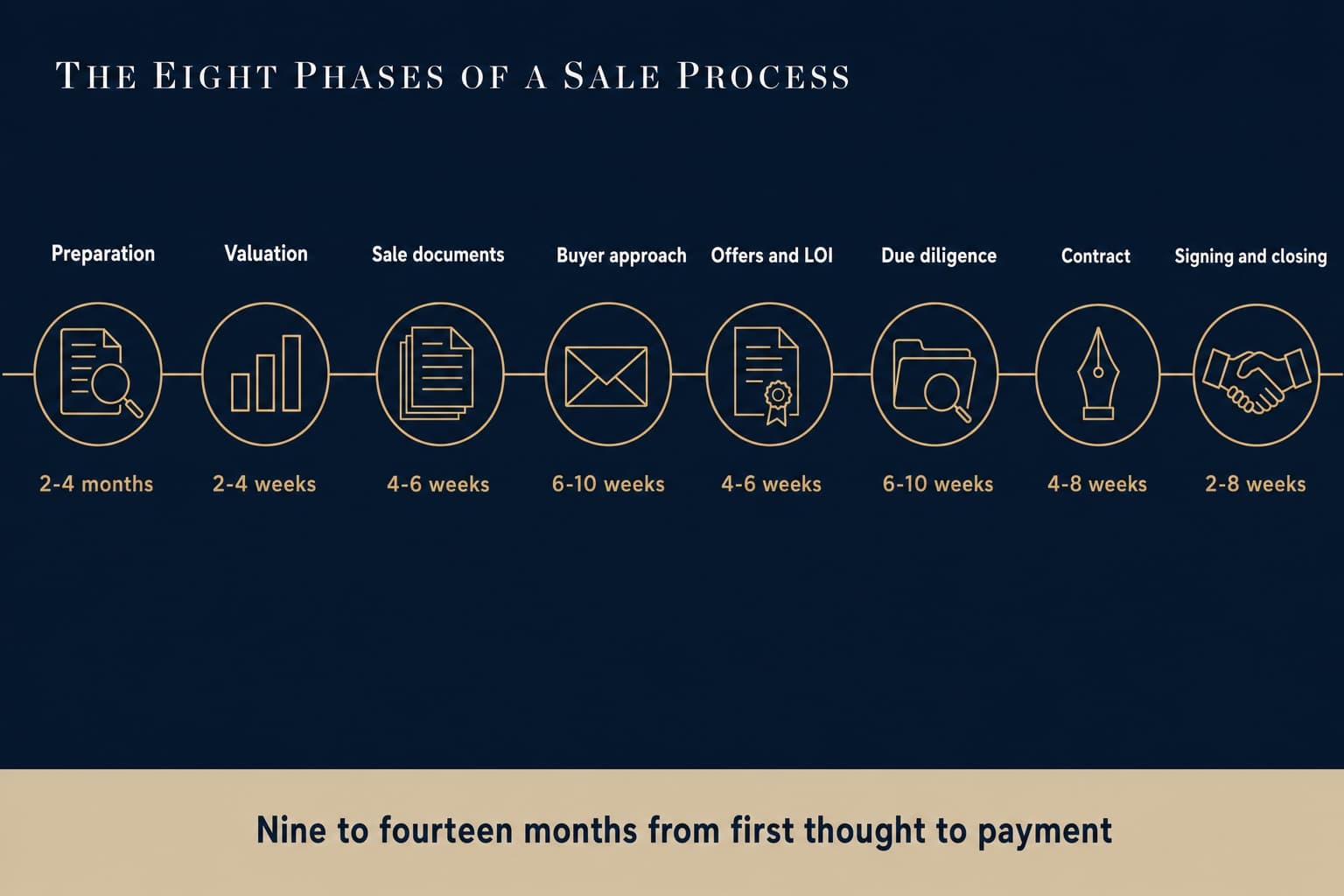
From the first serious thought to money in the account, a mid-market process typically runs nine to fourteen months. Preparation alone accounts for a third of that, and it is the third that decides the price.
The most common causes of delay are not dramatic: incomplete documentation, a shareholder who has not fully decided, a financing that takes longer than the buyer promised, and merger control filings that nobody planned for.
Next step
A first indication of value takes two minutes in the calculator. For anything beyond that, a conversation is quicker.