

Valuation theory offers a dozen methods. Mid-market practice uses one of them most of the time: a multiple applied to adjusted earnings, sanity-checked against a second approach. Everything else is either a cross-check or a negotiating position.
What follows is how a buyer actually gets from your profit and loss statement to a number, and why that number is not the amount you receive.
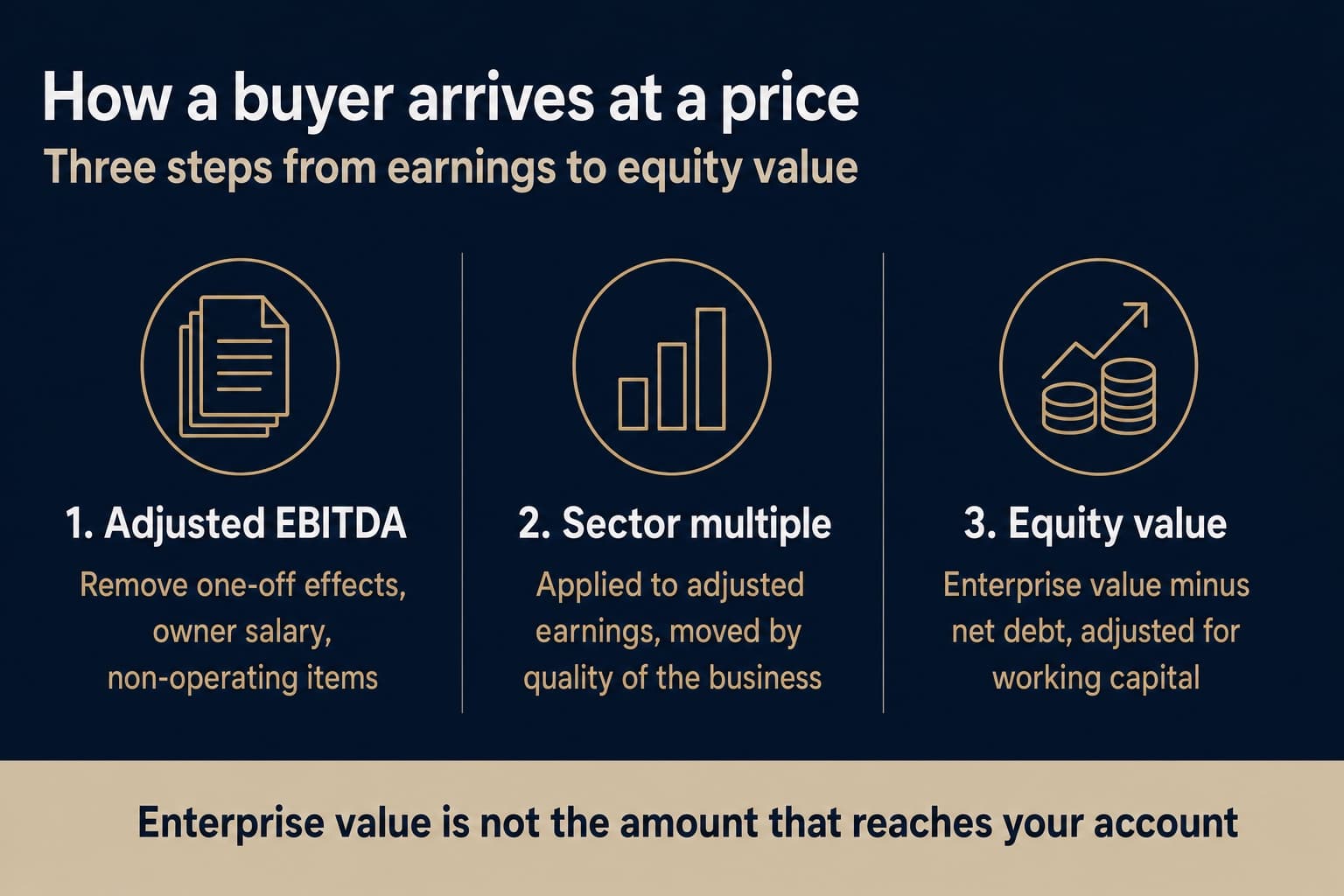
Step one: the adjusted earnings figure
No buyer values reported EBITDA. They value what the business would earn under normal ownership, which means adjusting for anything that is one-off, personal or non-operating.
The adjustments a buyer generally accepts: an owner's salary that differs from a market rate for the role, genuinely non-recurring legal or restructuring costs, private items running through the company, and rent paid to a related party above or below market.
Accepted without much argument: market-rate owner compensation, documented one-off costs, related-party rent corrected to market.
Contested regularly: capitalised development costs, provisions released, and anything described as a one-off that has appeared in three consecutive years.
The rule of thumb is simple: an adjustment survives if it can be documented and if it would still apply under a new owner. Adjustments that depend on the seller remaining in place tend not to survive.
Step two: the multiple
The multiple comes from the sector and the size of the business. Larger companies trade higher than smaller ones in the same sector, because they are less dependent on individuals and easier to finance.
Within that range, the qualitative characteristics of the business move the number. What raises it: recurring revenue under contract, a diversified customer base, a second management level that runs the business without the owner, documented processes, and a defensible market position.
What lowers it: dependence on the owner, customer concentration, a project business with no recurring component, an investment backlog in machinery or IT, and undocumented know-how sitting in a few heads.
Step three: from enterprise value to equity value
The multiple applied to adjusted earnings produces an enterprise value. That is the value of the operating business, not the amount that reaches your account.
Net financial debt is deducted: loans, leasing obligations, pension provisions and anything else the buyer treats as debt-like. Excess cash is added. Then working capital is compared against a normal level, with the difference adjusting the price in one direction or the other.
The gap between enterprise value and equity value regularly runs to twenty or thirty per cent in mid-market transactions. Owners who only ever hear the enterprise value number are frequently surprised at the end, which is avoidable by discussing both from the start.
Locked box or closing accounts
Two mechanisms determine when the price is fixed. Under a locked box, the price is set on the basis of a historical balance sheet date, and the buyer bears the economics from that date onward. Under closing accounts, accounts are prepared at closing and the price is adjusted afterwards.
A locked box gives certainty earlier and avoids a post-closing dispute, but requires the buyer to trust the reference accounts. Closing accounts are more precise and take longer to settle. Which is preferable depends less on theory than on how clean the numbers are.
Where DCF and asset value still matter
A discounted cash flow model appears in mid-market processes mainly as a cross-check, or where a business plan carries genuine weight, for example in a software company transitioning to a subscription model.
Asset-based value matters where the substance exceeds the earnings power: property-heavy businesses, or companies where a buyer is acquiring capacity rather than profit. In an ordinary profitable trading business, neither method sets the price.
Next step
A first indication of value takes two minutes in the calculator. For anything beyond that, a conversation is quicker.